Tuesday, October 29, 2019

There Is No Such Thing As American History - Only a Frontier

For yesterday's class, you were asked to watch the clip below from the series, "Mad Men," in which Sterling Cooper's creative head, Don Draper speaks suddenly and extemporaneously to his staff which has been pressed into working the weekend to craft an advertising campaign for American Airlines -- desperate to get out a message to counter the bad publicity surrounding a recent crash.


You were required to provide an analysis of Draper's message by applying basic concepts of American Exceptionalism as studied in class. Remember that we will have more activities such as this to apply and deepen your understanding of American Exceptionalism.  Hopefully, these activities will help deepen your understanding of the concepts we are studying and assist you in completing the assignment on American exceptionalism. Below is complication of some possible responses. 


American Airlines is no more about the past than America is---

In this line, Draper appeals to a sense of patriotism – equating the company with the nation.  At its core, American patriotism is based on freedom.  American Airlines represents freedom (Religiosity - source of utopian aspirations). On an individual level, the airline industry represents freedom to travel which is a means of exerting power over one's own life. In a larger sense, the power of flight broadens interstate commerce and allows America to do for itself and to expand by doing business in foreign lands (Industriousness - self reliance - getting ahead). This idea comes back full circle to patriotism because when Americans do business abroad, they instinctively bring their rugged individualism, their drive, their passion for freedom and their nation with them. As Conrad Hilton said, "It's my purpose in life to bring America to the world whether they like it or not." In this vision, American Airlines is at once America's chariot and ambassador.  

Ask not about Cuba, ask not about the bomb. We are going to the moon.

Here, Draper goes beyond optimism to conviction. In 1962, reaching the moon was yet to be done, but Don Draper is convinced that it WILL come to pass. America does not await a fate - America has a DESTINY as long as people dream and are bent on defeating the impossible. 

Build it and they will come – Field of Dreams 

America is a nation of DOERS -- take action and have dreams – Ted Kennedy, in his eulogy to his brother, Bobby said," As he (Bobby Kennedy) said many times, in many parts of this nation, to those he touched and who sought to touch him: Some men see things as they are and say why. I dream of things that never were and say why not."
Utopian aspirations and getting ahead tied up in one  -- 

There is no such thing as American history – only a frontier – 

Colonization was the frontier in America. This was followed by expansion west through the Louisiana Purchase, the exploits of Lewis and Clark, culminating in Manifest Destiny and extending on to the moon. There would always be another frontier for Americans because they refused to limit their imagination and as a people embraced man's inner need for challenges.

This line is also a bit counterintuitive – isn’t America’s history something to be proud of? Isn’t it the story of who they are as a people? What Draper means is that in the context of the post World War II era – America IS the future.  Why? How can Draper be sure? Because America saved the world from Nazi tyranny. America had rebuilt Europe and fed the hungry. America was the leader of the Free World and protected the world from Soviet hegemony.


Thursday, October 24, 2019

American Republic Test Review

Below you will find a summary of the review for the upcoming American Republic Test, which will take place on Friday, November 1, 2019.

Format - 5 points - Multiple Choice, 17 points - Matching, 33 points - Short Answer (4 questions) 


American Republic Test Topic Breakdown

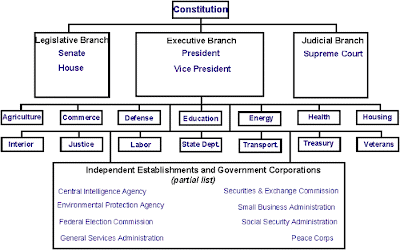
Republican Government Structure

·      Legislative Branch – Congress
·      Executive Branch – President, Cabinet & Government Agencies
·      Judicial Branch – Supreme Court, Court of Appeal, District

Heritage

·      Parallels between structure of British parliamentary system and American Republicanism
·      Differences in power of federal government in US vs. British model
·      The British theory of balance in the body politic vs. American accountability and differences in perception regarding the role of government in society


Function (i.e. How a bill becomes a law)

·      Requirement for bill to be passed by both houses
·      Requirement for bill to go through committee (sometimes several)
·      The Process – Introduced, referred to committee, committee hearing, tabling, reported out, calendared, floor reading, debate and amendments, role of conference committee, engrossed bill vs. enrolled bill  
·      Importance of bipartisanship and compromise
·      Veto and overriding veto

Elections, Terms and Responsibilities

·      Term of office for congressman, senator, president
·      Number of members of the House of Representatives and the Senate
·      Role of President as Head of State as well as leader of the Executive Branch
·      Role of the Vice President in the legislative process
·      Rationale for terms of office as outlined
·      Representation by population, equal representation and rationale for each
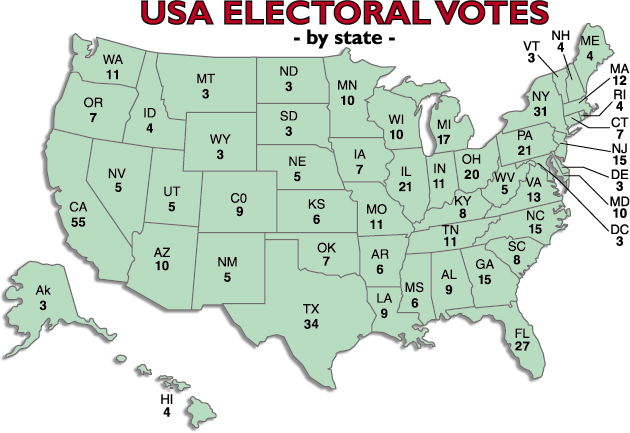
·      The electoral college  - structure, rationale, role of electors

Checks and Balances

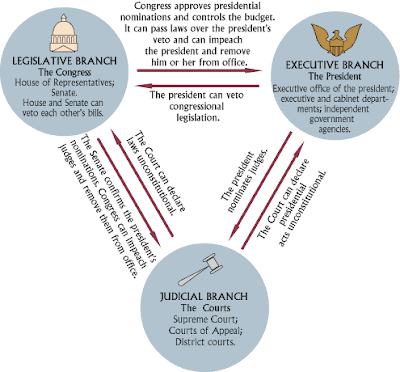
·      Between Legislative Branch and Executive Branch
     Between Executive Branch and Judicial Branch
     Between Judicial Branch and Legislative Branch

Upcoming Dates To Pay Attention To

October 30 - We will hold a make up class at lunch on this day.


October 31 - You will be expected to write an in class essay in response to material that will be applied to the elements of American exceptionalism. Class will continue through lunch. Make appropriate arrangements. 

November 1 - American Republic Test (Material will be based on the blog entry "Crash Course in the American Republic") Review blog entry to come soon.

As always, let me know if you have any questions.

Tuesday, October 15, 2019

What Happened - The 2016 Election

The 2016 election was quite the ride for the American people. Below, we will explore some facets of the election and through this consider the way in which voters make their decisions. In order to do so, you will need to examine your own decision making matrix and how those tendencies influence what you believe to be true and real.


As a place to begin, take the test below. Save/print your results and bring them to class for October 17:


Here's some analysis on what the test means.

Here's a breakdown on the personality types.

http://www.humanmetrics.com/personality/type


Issues

  1. Complete the survey to determine your own political profile and who you line up with on the issues of the 2016 Presidential campaign. Print/save the results and bring them to class for October 17. 
  2. Then review the article below to identify the importance voters placed on the top issues. What were the top issues?  http://www.people-press.org/2016/07/07/4-top-voting-issues-in-2016-election/
  3. Examine the gap between Republicans and Democrats regarding the importance they placed on various issues.What does this say about the priorities of a Trump or a Clinton voter? What are the likely differences between these voters? What are the similarities? http://www.people-press.org/2016/07/07/4-top-voting-issues-in-2016-election/4_2-4/ 
  4. Examine the gap between age groups regarding the importance they place on various issues?What are the likely differences between age groups? What are the similarities?  http://www.people-press.org/2016/07/07/4-top-voting-issues-in-2016-election/4_3-4/

Personality

Read the personality profiles of Hillary Clinton and Donald Trump 


Read the following article for a different take on their personalities.


For October 17,  answer the questions below:
  1. If you were only voting on personality AS DEFINED BY THE ARTICLES ABOVE, who would you vote for and why?
  2. If the American voter was voting on personality AS DEFINED BY THE ARTICLES ABOVE, how do you think the vote would break down by age and gender?

The following information is to be considered after the October 17 class.

Voters and Voting Blocks

Take a look at the web page below. This page allows you to make use of actual data with respect to demographics and voting patterns to run some "what if" scenarios. Experiment with the data and come up with three takeaways from your scenarios with an eye to explaining how the election  "turned out".


The Horse Race and Strategy

Use the interactive map below to help you build a prediction model for how you think the next presidential election will turn out.


Polls, Schmols - We Don't Need No Stinking Polls

Sometimes things can be a lot less complicated than they seem. In the article below, a college professor has come up with thirteen key True/False questions that have correctly predicted the US presidential elections for 30 years where "True" is positive for the party in power and "False" is positive for the challenger.


Friday, October 4, 2019

Crash Course in the American Republic

Below you will find a summary of our look at the structure of US government and how it operates as outlined in the Constitution.

Heritage

Remember the context of America's birth. There was widespread opposition to the heavy-handedness of British government and hostility to the concept of a class society. Americans were suspicious of power that was too easily concentrated and wielded in the hands of a few.

They rejected the British theory for a need to "balance" the democracy of the common people with the "wisdom" of the aristocracy and the monarchy. Canada's political system was developed with this British mindset in the wake of the Civil War, which most British parliamentarians agreed was the result of "rabble rule". In short, too much democracy made people think that they had "rights" to break up the country. From the British view, this was the fatal flaw in the "Great Experiment" of America.

Consequently, our political structure in 1867 had the House of Commons as our parliamentary body. Members were elected through representation by population. The executive function of the government was concentrated within parliament -- the Prime Minister and cabinet, who were chosen directly from the political party with the most seats.

The Senate was an appointed body and was to offer a "sober second look at legislation". Clearly, the Senate was designed as a place for a Canadian aristocracy, which had to be developed. As such, once appointed senators were immune to public accountability. Once legislation passed the Senate, it was signed into law by the head of state, the Governor-General (the Crown's representative).

The Canadian system mirrors the British model and thereby concentrates power in the hands of the government, and indeed in the most populous provinces, as higher population means more power. The government with a majority can pass whatever it pleases during its term regardless of opposition maneuvering. The rules of parliament support this, as the consequence of losing a vote is the fall of the government. So once a decision has been made, everyone in government must support it or risk losing everything.

The Canadian system reflects the balance of the body politic -- democracy in the House of Commons, the aristocracy in the Senate, and the monarchy in the Governor-General.


How a bill becomes a law in Canada...


http://www.youtube.com/watch?v=FoR14KLq_kg&feature=related


US Government - A System of Checks and Balances


The United States government retains the same basic structure as the British model. There are two parliamentary bodies that create and pass legislation (the House of Representatives and the Senate) and a head of state that signs legislation into law (the President). However, this is where the similarities end. Americans rejected appointed positions almost entirely, save from the federal cabinet.

The House of Representatives is elected every two years and is chosen through representation by population, like our House of Commons. However, executive function of the Prime Minister does not exist in the House of Representatives. Instead, the position of President holds these executive powers. This clearly dilutes the power that would otherwise be concentrated in the House and as such is a check on the power of Congress.

Unlike the Governor-General, the President serves as more than just head of state. In the position of President, Americans combined many of the functions of Prime Minister with the functions of the Governor-General. As well, the President is Commander in Chief -- the senior military officer of the country. Although even with this power, the Constitution does not give the President the authority to declare war. He must have the support of Congress (the House of Representatives and the Senate) to declare war. This is a check on the power of the President.

The President also has the power to pick anyone to sit in his cabinet and he has the power to make appointments to various positions including the Supreme Court. However, once again Congress has a check on this power because they have the constitutional responsibility to review and approve presidential appointments.

The Senate has a special place in the legislative process. It is designed to provide a more unifying view that is somewhat removed from the political opinion of the moment. While congressmen (members of the House of Representatives) have two year terms, senators have six year terms. As such, they are expected to be more motivated to take positions with a view of what is best for the country rather than a congressman, whose political survival is tied to his responsiveness to the local public who elects him and will pass judgement on him very soon again. The compliment of the Senate is also different from the House. The Senate is filled by equal representation by state. Therefore, North Dakota with a small population will have the same amount of power as California, which is considerably larger. With 100 senators today, the framers wisely set up a solution to a potential tie -- the Vice President casts the deciding vote.

Bills can and do start in either legislative chamber of Congress, but ultimately have to be agreed upon in both chambers before going to the President's desk to be signed into law. Here again, the President has the ability to check the power of Congress, as he can withhold signature and veto any legislation. Congress may only override a Presidential veto if in fact it can produce a two thirds majority in both houses with respect to the bill in question. If this is achieved, the President is obligated to sign the bill into law - another example of congressional ability to check the power of the President.


How a Bill Becomes a Law


http://www.youtube.com/watch?v=_TI8xqLl_-w


The key to making this system work is bipartisanship and compromise. Americans expect their government to get along and get things done. When the atmosphere in Washington D.C. is poisonous, it is easy to see how the work of government can be ground to a halt. The present public dissatisfaction with both the President and with Congress has been their inability to get along and solve the problems confronting the country. In future elections, Americans will have to decide who is likely to not only have the right prescription for what ails the economy, but perhaps more importantly who can build the consensus required to move forward.

Elections

As previously stated, the Constitution requires elections be held every two years for the entire House of Representatives. These members are elected within congressional districts much like our ridings for individual MP's. There are 435 members of the House of Representatives.

Senators are up for election every six years, but only one third of the Senate is up for election at one time. With two senators per state, there are 100 senators in total. In the event of a tie vote, the Vice President casts the deciding vote. Senators are elected statewide.

The Presidency has a unique process for election. While every person of voting age is eligible to vote for President, not every vote counts the same. That is to say, the President is not elected by popular vote; the President is elected through the Electoral College.


Each state has a number of electoral college votes equal to its congressional representation in both houses. Actual "electors" are chosen by the states to formally vote for President and Vice-President. In fact, they vote based on the popular vote held on election day in their respective states. Except in the cases of Maine and Nebraska, it is a "winner take all" proposition. In other words, the candidate who wins the popular vote in the state wins all the electoral college votes for that state.

The system was initiated at a time when a cross country campaign was not really very practical and as such the electors chosen were those who would know something of the candidates up for election. In recent elections, there have been serious criticisms of the system and calls to repeal it. Most seriously in 1968, Richard Nixon defeated Hubert Humphrey 301-191 in the electoral college, but Nixon only won the popular vote by a little more than 500,000 votes. Although there was a move to make a constitutional amendment that was supported by Nixon as well, it died in committee in Congress and was never raised again legislatively.

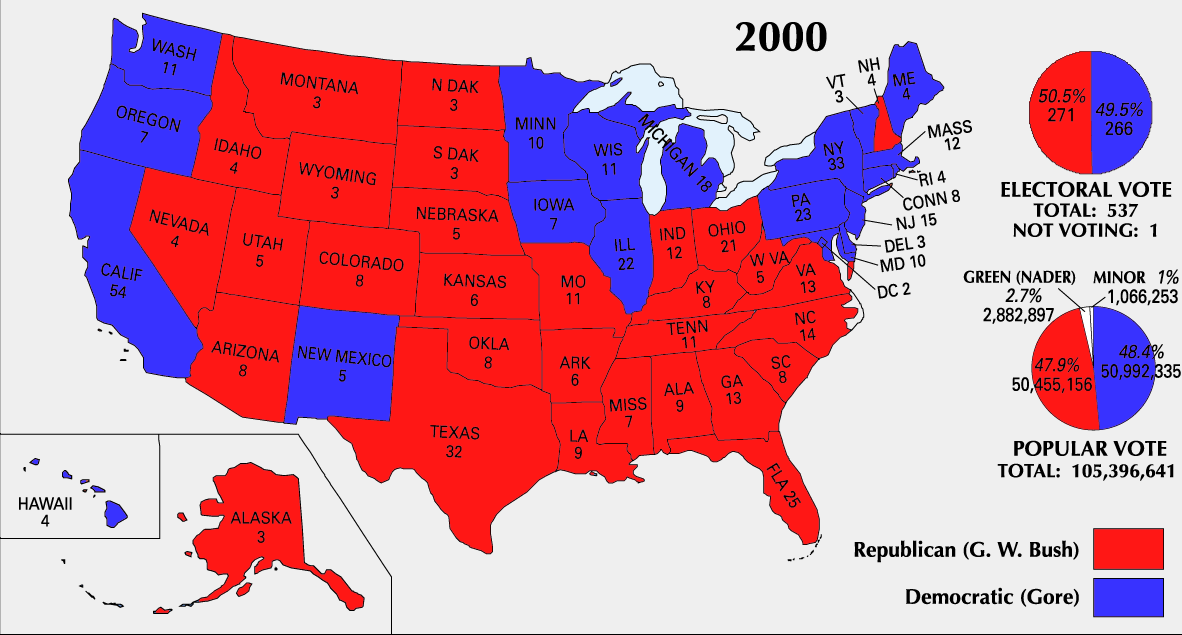
In 2000, George W. Bush defeated Al Gore 271-266. However, Bush lost the popular vote narrowly. Bush received 50,456,002 votes while Gore finished with 50,999,897. While there was some criticism of the system, it did not rise to the level of action during Nixon's era.


Ultimately, the system has stood the test of time because it provides a balance between large and small states. Without the electoral college, presidential candidates would likely ignore certain states and indeed entire sections of the country because they would be inconsequential to their election. The electoral college makes the interests of small states a matter of some importance and ensures that their concerns will not be left out of the national discussion. This approach is in line with the spirit of Alexis de Tocqueville's that America must put safeguards in place that work against the "tyranny of the majority".

http://fivethirtyeight.com

http://www.270towin.com

America as a Republic

There's a couple of things America got right… See the video below. At various points, I will post items found in popular culture that help to illustrate core American values and the roots of American Exceptionalism. This one seems to be a good fit based on the blog title "Crash Course in the American Republic" -- How can one not think of cars and freedom with a title like that?

https://www.youtube.com/watch?v=xqWxgCZ1TQE


Republicanism in America means more than just being democratic -- it avows that the people have unalienable rights. This is non-negotiable, constitutionally. Theoretically, in a pure democracy, if majority rules, then the majority can vote to take away the rights of a minority.

Alexis de Tocqueville wrote about the potential "tyranny of the majority," where dominant or more conventional opinions might discourage people from considering other opinions.


I know of no country in which there is so little independence of mind and real freedom of discussion as in America. ... In America, the majority raises formidable barriers around the liberty of opinion: within these barriers, an author may write what he pleases; but woe to him if he goes beyond them. ... Before publishing his opinions, he imagined that he held them in common with others; but no sooner has he declared them, than he is loudly censured by his opponents, whilst those who think like him, without having the courage to speak out, abandon him in silence. He yields at length, overcome by the daily effort which he has to make, and subsides into silence, as if he felt remorse for having spoken the truth.

Fetters and headsmen were the coarse instruments which tyranny formerly employed; but the civilization of our age has perfected despotism itself, though it seemed to have nothing to learn. Monarchs had, so to speak, materialized oppression: the democratic republics of the present day have rendered it as entirely an affair of the mind, as the will which it is intended to coerce. [When] the body was attacked in order to subdue the soul ... the soul escaped the blows which were directed against it, and rose proudly superior. Such is not the course adopted by tyranny in democratic republics; there the body is left free, and the soul is enslaved. The master no longer says, “You shall think as I do, or you shall die”; but he says, “You are free to think differently from me, and to retain your life, your property, and all that you possess; but you are henceforth a stranger among your people. You may retain your civil rights, but they will be useless to you, for you will never be chosen by your fellow-citizens, if you solicit their votes; and they will affect to scorn you, if you ask for their esteem. You will remain among men, but you will be deprived of the rights of mankind. Your fellow-creatures will shun you like an impure being; and even those who believe in your innocence will abandon you, lest they should be shunned in their turn. Go in peace! I have given you your life, but it is an existence worse than death.”

Exerpt from Democracy In America by Alexis de Tocqueville

(ed. Richard D. Heffner; New York: The New American Library, Inc., pp.117-118)
de Tocqueville strongly argued for the need to protect unpopular minorities from inevitable efforts to use democractic means to legislate against them.

Although the root word of "Republicanism" is "republic", but the former is different from the latter. Webster's dictionary defines a "republic" as, " a government having a chief of state who is not a monarch and who in modern times is usually a president... while "republicanism" refers to an ideology.

Tuesday, October 1, 2019

Finding the Underlying Assumptions of American Exceptionalism

Now that we have taken time to discuss and consider some of the key elements of American exceptionalism, it is time to give thought to some of the underlying assumptions of this concept. Below, you will find a few brief examples of these assumptions. You are invited to come up with your own as we make our way through the course. Also, you may build on the assumptions already listed and provide different examples. When doing so, use the following template:


  • identify the assumption
  • provide a written description of the assumption - What does it look like? Where can you see it? There are no restrictions here. You can find assumptions of American exceptionalism in art, music, film, popular culture, politics -- anywhere you care to look really.
  • specifically explain the connection or relationship between your assumption and a particular element of American exceptionalism
From time to time I will provide you with an example in class as well. 

You will be expected to post your underlying assumptions of American exceptionalism on Chalk Up. Between now and January 13, 2019 you will need to post TWO different assumptions. Between February 4, 2020 and May 4, 2020 you will need to post TWO more assumptions. 


Informality

Egalitarianism (identification with the middle class) and Community Life (neighborliness) are the forces that cause Americans to intuitively prefer informality in most settings. In the latest presidential election, Donald Trump was perceived to be "an average guy" and this perception was based on such things as Trump's "plainspokenness" and his reliance on simpler language and "common sense" to describe policy prescriptions instead of the kind of technocratic language that Hillary Clinton used to showcase her depth of knowledge and familiarity with public policy issues. 

American presidential races have often seen victory go to the candidate who can most clearly identify with the American people. George W. Bush defeated both Al Gore and John Kerry for this reason despite the fact that both Democrats were perceived as "more knowledgeable" than their respective opponents. Bill Clinton defeated both George H.W. Bush and Bob Dole for a variation on the same theme. Clinton was perceived as "better understanding" the challenges confronting ordinary Americans. As well, both Clinton and Barack Obama were seen as "more hip" and "in touch" with people than their opponents. 

Ronald Reagan was clearly perceived as "warmer" and "easier" around the public than Jimmy Carter and Walter Mondale. In particular, Carter lost the election because his campaign tried to cast Reagan as a dangerous and simple minded extremist who would cause World War III with his jingoistic talk and his finger on the nuclear button, but the image of Reagan that people saw during the debate was a smiling, friendly and seemingly reasonable person who managed to sum the election up in one simple question, "Are you better off today than you were four years ago?"

Perhaps Americans dislike formality because it reminds them of the class system inherent in their British lineage -- a system which they fought to break away from.   

The Underdog and The Belief that Anything Is Possible

Americans love to cheer for the underdog in sports. Super Bowl III is still regarded as one of the greatest upsets in sports history and because of this it remains one of the most popular championship games of all time. No one believed the AFL Champion New York Jets had any chance against the veteran and star studded NFL Champion Baltimore Colts. But Joe Namath, the Jets quarterback shocked reporters when he guaranteed that the Jets would win the game -- and they did. Namath's legend is in large part tied to this one game and the fact that he called it.

The underdog and the "anything is possible" theme is after all the story of the American Revolution -- where a small band of colonies take on the most powerful nation on the face of the earth and win. Believing that "anything is possible" validates a lot of the key values of exceptionalism. It requires faith not only in oneself but faith that "everything will turn out alright," which connotes religiosity. Believing that "anything is possible" also implies humility, which supports egalitarianism. More importantly, when the underdog wins, arrogance is punished and true equality is vindicated -- the winning is less important than the respect that comes from winning and the proof that "everyone has a chance to succeed" is the most important lesson learned.

This theme also reinforces the idea of industriousness. In particular, the underdog needs to commit to hard work to beat the favorite. Also, being self-reliant is indispensable to an "anything is possible" mentality. You need to believe in yourself and in the possibilities of achievement while everyone else is telling you that you have no chance. 


http://www.businessinsider.com/25-nike-ads-that-shaped-the-brands-history-2013-8#failure-and-the-michael-jordan-underdog-myth-1997-12

http://www.businessinsider.com/25-nike-ads-that-shaped-the-brands-history-2013-8#tiger-woods-shows-off-1999-14

http://www.businessinsider.com/25-nike-ads-that-shaped-the-brands-history-2013-8#my-better-is-better-2008-21


Only in America

Extending the "anything is possible" thinking leads us to perhaps the purest expression of exceptionalism -- the "only in America can this happen" theme. Another manifestation of this is the American Dream, but we will get to that later in the course. "Only in America" can apply to a "rags to riches" story where an immigrant can come to the country penniless and rise to incredible wealth. Industriousness and all its aspects - self-reliance, hard work, and getting ahead are all reinforced to a high degree.

Politicians love to tell the "only in America" story when they talk about their own backgrounds as it helps show their natural connection to egalitarianism

https://www.youtube.com/watch?v=bqL2ZiP8AvE

https://www.youtube.com/watch?v=hbaP0Jzd6QA


Making a Difference


Making a difference or having an impact has always been something that Americans have aspired to and respected. When Benjamin Franklin emerged from the Constitutional Convention in Philadelphia, a certain Mrs. Powell called out to him and asked, “Well, Doctor, what have we got – a republic or a monarchy?”


Franklin responded, “A republic, madame – If you can keep it.”

With those words, Benjamin Franklin unveiled a great truth – that the American nation was qualitatively different than any other that had come before and that in order to maintain her genuinely unique character, her citizens would have to play an active role. "We, The People" have a responsibility to make a difference thereby protecting the Republic. 

Thomas Jefferson wrote the Declaration of Independence as "an expression of the American mind". 

See the letter from Jefferson to Henry Lee where he describes the Declaration of Independence as "an expression of the American mind". 


"We hold these truths to be self-evident, that all men are created equal, that they are endowed by their Creator with certain unalienable Rights, that among these are Life, Liberty and the pursuit of Happiness. —That to secure these rights, Governments are instituted among Men, deriving their just powers from the consent of the governed, —That whenever any Form of Government becomes destructive of these ends, it is the Right of the People to alter or to abolish it, and to institute new Government, laying its foundation on such principles and organizing its powers in such form, as to them shall seem most likely to effect their Safety and Happiness."

Jefferson's writing was a source of utopian aspirations and as such did not seek to describe America as it was but instead make manifest the America that needed to be. The phrase "All men are created equal," spoke to egalitarianism and equality of human dignity. With these words, Jefferson sought to make a difference -- specifically, he took action throughout his political life to codify equality of human dignity by seeking to end slavery. 

See the short article below:


Jefferson's other actions to stop slavery included but were not limited to:

  • His work on the Virginia Constitution, which he hoped would lead to abolition (1776);
  • His leadership in crafting a Virginia bill aimed at outlawing African slave importation (1778);
  • His proposed ban on slavery in the Northwest territories (1784);
  • His attempts at advancing the end of slavery through gradual emancipation and deportation  

Jefferson's efforts to end slavery were motivated by his prescient fear that slavery would result in a civil war that would tear the nation apart. 

See Jefferson's letter to John Holmes


Yet, while he acted politically to make a difference, personally he continued to own slaves. For a better understanding of this contradiction see the article below.


Just Do It

"Making a difference" requires action -- and American culture reveres those who act. Note the ubiquitous nature of this concept -- the honorable place that taking action holds in American culture.

Dirty Harry Callahan is a detective made famous by Clint Eastwood in a series of popular films. Callahan is surrounded by a city in decay and crime but he acts to enforce the law -- often in spite of the danger to himself and the seemingly impossibly long odds against him. 

Nike launched one of the most popular advertising campaigns in history with the catch phrase, "Just Do It."

Larry the Cable Guy immortalized the phrase "Git-R-Done." See his thoughts on what it means and how it became popular.

https://www.youtube.com/watch?v=4TU-li1BqZ4

Political slogans have also tried to catch on to the American need to act -- consider the slogans of the most recent presidential election winners:


  • Yes We Can
  • Make America Great Again
As a matter of fact, you'll remember Donald Trump criticized Hillary Clinton for not having the "stamina" to be president. He also called Jeb Bush "low energy". Both attacks were designed to tap into the preference that Americans have for doers and allowed Trump to draw a contrast that he saw as favorable for himself. 

President Obama also chimed in on this issue after the election, suggesting that Clinton perhaps failed to work as hard to earn the votes she needed to all across the country. According to President Obama, she just had to get out and do it.


Another example of the "just do it" principle is after 9/11, when Americans signed up to join the military to fight terrorism.