Tuesday, April 27, 2021

The Cold War in Five Minutes

As time went on, the Cold War became less about Europe and its perceived security and more about a battle of ideas -- a choice between individual freedom and free market capitalism vs. state control and socialism... How did we get from a disagreement about Europe to this ideological battle?


You are to prepare a brief oral presentation based on a number of the following topics as assigned in class. Initials are beside your topic:


Theaters of the Cold War

  • Korean War JB

  • Khrushchev and De-Stalinization 

  • 1956 Hungarian Revolution CP

  • 1953 Iranian coup d'etat  VB

  • Congo Crisis CR

  • Cuban Revolution, Bay of Pigs and Cuban Missile Crisis  RR

  • 1968 Czechoslovakian Invasion and the Brezhnev Doctrine AT

  • Vietnam War MK

  • Nixon goes to China 

  • 1973 Chilean coup d'etat and Operation Condor 

  • Detente, SALT, Helsinki Accords 

  • SALT II, Iranian Revolution and US Hostages, Nicaraguan Revolution IBM

  • Soviet invasion of Afghanistan AH
  • Berlin - the Rise and Fall of the Wall SJ


Other Topics Which Shaped the Nation During the Cold War:

  • Army - McCarthy hearings 

  • JFK, RFK, Martin Luther King Jr. assassinations AR

  • Hippie/counterculture movement 

  • Watergate Scandal  JP

  • Three Mile Island nuclear accident BJ
  • The Space Race FT
  • Strategic Defense Initiative - Star Wars LK


Your goal is to give a brief five minute overview of your topic(s) with an eye towards the following:


  • Summary of what happened

  • Relationship to the Cold War (i.e where do US and USSR fit in?)

  • Ultimate Impact

  • A one page report that will be distributed to the class with all of your topics included
APA format - submit it in a separate document


Presentations will begin May 5 and likely go through to May 11

The Cold War


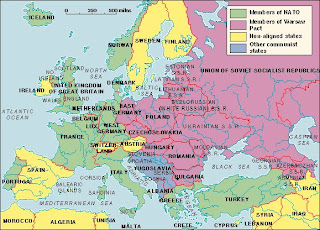
The Cold War is a term used to define a decades long political, economic and military struggle between the two most powerful allies surviving World War II, the Soviet Union and the United States. It included massive alliances with many of the world's other countries and dominated the foreign policy of every country during this era. The struggle began because of disagreements concerning postwar Europe - in particular the occupation and rebuilding of, and eventual withdrawal from Germany. As well, there were difficulties concerning the eastern "buffer" zone (or "Iron Curtain" as Winston Churchill called it) that the Soviet Union insisted upon which encompassed Poland, Czechoslovakia, Albania, Bulgaria, East Germany, Hungary, and Romania.

Tehran, Yalta and Potsdam Conferences


The Ideological Divide Between the Soviet Union and the United States


Stalin Drops the Iron Curtain


While there was considerable concern in the west that this expanded Soviet territory would mean the emergence of a new threat to European peace, a long and costly war marginalized the voices who advocated confronting Stalin, the Soviet dictator over his demands. Consequently, the United States organized NATO (North Atlantic Treaty Organization - countries at the time included Denmark, Canada, Belgium, France, Iceland, Italy, Luxembourg, Netherlands, Norway, Portugal, United Kingdom, United States) to be a military umbrella which coordinated the resources of its member countries against Soviet aggression and the spread of communism worldwide.

The Need for Long Term Post War US Involvement in Europe


Greece, Turkey and the Truman Doctrine


The Marshall Plan - Diffusing Hunger in Europe to Halt the Spread of Communism


Bizonia, Trizonia and the Emergence of West Germany

Berlin Blockade and the Birth of NATO


Throughout the Cold War, there was very little "hot conflict" which involved the main participants - the US and the USSR. Instead, each side supported another nation against a local antagonist who was in turn supported by the rival side. Often these conflicts were based on local self determination issues. In other words, the United States and NATO supported efforts aimed at democratization while the Soviet Union supported communist regimes. However, in some instances, the United States would give aid or military support to dictatorships in places where the strategic support of that government against communism was important to stop the spread of Soviet influence. As time went on, the Cold War became less about Europe and its perceived security and more about a battle of ideas -- a choice between individual freedom and free market capitalism vs. state control and socialism.

The advent of nuclear weapons added another dimension to the Cold War conflict. The United States was first to create and then detonate a nuclear device, using the bombs dropped on Hiroshima and Nagasaki to bring a quick end to the war in the Pacific without the need for a boots on the ground invasion. Speculation has suggested that the United States went ahead with using the atomic bomb as a result of the growing disagreements with the Soviet Union over Europe after the fall of Germany. Specifically, the US believed that if the Soviet Union was involved in a land invasion of Japan which was expected to be protracted and bloody, Stalin would use his casualty count to buy him more territory in Asia. The atomic bomb at once signalled the military superiority of the United States and avoided the potential spread of Soviet communism. This advantage was, of course, short lived. Through their own intelligence on the Manhattan Project, the Soviets created and tested their own nuclear copy of "Fat Man," the bomb dropped on Hiroshima in 1949. This test marked the beginning of an era where the US and USSR were considered "superpowers" and the start of an arms race which would continue well into the 1980's.

The Arms Race

Friday, April 23, 2021

Towards World War II and the War Itself

Here are some links to material that will review/go into further depth on the subjects covered in the lecture concerning the lead up to World War II and the war itself. 


The Roaring 20's

http://www.youtube.com/watch?v=SclJ94h2oyQ

https://www.youtube.com/watch?v=RN7ftyZigYs


The Stock Market Crash and the Great Depression

http://www.youtube.com/watch?v=nyAZGqFtVjw&feature=related


With regards to World War II, be familiar with the following:


•The impact of the Treaty of Versailles as a cause of World War II


•The rise of Fascism in Europe and Germany in particular


•Hitler's rise to power and then his downfall


•The evils of the Nazi regime


•Why the nuclear bomb was used on Japan


Causes of World War II


http://www.historyonthenet.com/world-war-two-causes/


World War II - The Whole Story By Animation in Under Six Minutes

http://www.youtube.com/watch?v=lm5SxG68KSM&feature=related

Adolf Hitler Documentary

https://www.youtube.com/watch?v=cHwwAB2THUE

Hitler - Time Magazine Man of the Year

http://www.history.ucsb.edu/faculty/marcuse/projects/hitler/sources/30s/391time/391timemanyear.htm

Fascism

http://departments.kings.edu/history/20c/fascism.html

Nuremberg Rally

http://www.youtube.com/watch?v=4MaWSTPSA2k


https://museums.nuernberg.de/documentation-center/national-socialism/the-nazi-party-rally-grounds/

https://www.smithsonianmag.com/smart-news/nuremberg-decides-conserve-nazi-rally-grounds-180972244/

Nuremberg Trials

http://famous-trials.com/Nuremberg

Wednesday, April 14, 2021

World War I

Today, we discussed the background to Canada's development from 1867 (immediately following the Civil War) to 1918, the end of World War I. It is often said that Canada's true independence is achieved through its sacrifice on European shores in support of Britain and its allies during World War I. In the end, Prime Minister Robert Borden insisted that Canada sign the Treaty of Versailles instead of having the expected custom of Britain signing on Canada's behalf.


The war was Canada's most significant national achievement. Canada was the first former colonial country to defeat a major European power on a European battlefield. Canada's effort was considerable -- 620,000 troops were mobilized out of a population of 7.2 million. Of those Canadians who went to war, 173,000 were wounded and 67,000 were killed. In comparison, the United States entered the war late (1917) 204,000 were wounded and 117,000 were killed out of a population of 92 million. Canada's industrial effort to support the war was also strong and showed the world that Canada had a growing industrial base.

However, the war was also a bitter domestic issue, causing tensions that would remain for some time between the English, who felt it Canada's duty to participate and the French, who felt no such loyalty and considered the war a European problem.
The resulting draft and subsequent losses only made the racial conflict worse.

In many important ways, World War I shaped Canada as a country. However, in America's relatively short involvement, it became clear that America had grown powerful enough to shape the world. At the time of US entry, the war was not going particularly well for Britain and its allies. Russia had fallen to revolution and the Tsar was removed. A power struggle would begin in Russia that would culminate with the communists under Lenin taking over.

Although he dragged his feet on an agreement in the hopes that workers in Germany would rise up and support the workers in Russia, sparking a European communist revolution, Lenin was forced to sign the Treaty of Brest-Litovsk, ending the war on the eastern front. The treaty actually required Russia to free Estonia, Latvia, Lithuania, Poland, Finland, and the Ukraine. These countries would serve as a buffer zone for Germany, creating "space" between itself and Russia in the event that there would be another military mobilization.

Ultimately, Lenin was hardly in a position to bargain hard with Germany. After all, it was Germany that supported his efforts to go to Russia to lead the revolution in the first place as a way to undermine the Tsar. Additionally, when Lenin delayed making the deal, the Germans tired of his dithering and resumed their advance on Moscow. The Russian army was still in disarray and the Germans advanced one hundred miles in four days. It was at this point that Lenin made the deal. Many didn't like the terms, but he had promised to get the country out of the war, and failure to do so now would result in his own demise.

This left Britain and France without their major ally and allowed Germany to concentrate its efforts on the western front.

However, the United States entered the war at around the same time that Russia was falling into chaos. Its industrial and military capacity was quickly ramped up and ultimately became the decisive factor in forcing Germany to retreat and eventually surrender.

The emergence of the United States as a world power and the end of the colonial monarchies signaled that the world was changing dramatically.


World War I Summary


The Treaty of Versailles and Its Impact

http://www.ushmm.org/wlc/en/article.php?ModuleId=10005425

The Bolshevik Revolution (Russian Revolution)

https://www.history.com/topics/russia/russian-revolution

The Treaty of Brest-Litovsk


The Fall of the Romanov Dynasty

Thursday, April 8, 2021

Captains of Industry or Robber Barons?

It was the Roman emperor and philosopher Marcus Aurelius who said, "A man's worth is no greater than the worth of his ambitions." The truth of this statement expands far past the ruins of an Ancient Rome and into the coffers of those great businessmen of America who changed the face of commerce in the country during the latter years of the nineteenth century and on into the twentieth century. Men such as J.P. Morgan, Cornelius Vanderbilt, Andrew Carnegie, and the colossal John D. Rockefeller represent the age where a young nation stretched its legs into the long fitting pants of capitalism. Many saw these giant men of commerce as robber barons, manipulators of huge monopolies that preyed on the public. Many others view them as validation for the American Dream. In such a light, they are pioneers of business in the "pursuit of happiness" or "Captains of Industry". Your task is to determine which of these interpretations is true using online resources and present your argument in the form of an essay.

Were industrial leaders of the late 19th and early 20th century captains of industry or robber barons?


The essay is to be 2-3 pages, Times New Roman 12 point, standard margins, APA style with  at least 4 different sources. 


DUE DATE: Thursday, April 29, 2021

The Gilded Age

The period of industrialization that led to the great creation of wealth as a result of new technologies and unparalleled growth was known as the Gilded Age...

See the link below for more background:


https://www.history.com/topics/19th-century/gilded-age


See how some of the giants of industry lived in this era:


Kykuit-the country home of John D. Rockefeller Sr., John D. Rockefeller Jr., Nelson A. Rockefeller, and their families...


https://hudsonvalley.org/historic-sites/kykuit-the-rockefeller-estate/


http://www.abbeville.com/bookpage.asp?ISBN=0789202220


Andrew Carnegie Estate


https://www.cooperhewitt.org/carnegie-mansion-history/


Cornelius Vanderbilt lived in a modest home, but his descendants made up for it.


https://untappedcities.com/2012/02/01/remnants-of-the-vanderbilt-mansion-in-new-york-city/


http://thegildedageera.blogspot.com/2012/07/the-cornelius-vanderbilt-ii-mansion-new.html


Jay Gould


http://www.lyndhurst.org/


Industrial Giants


JP Morgan - Banking


Andrew Carnegie - Steel (U.S. Steel)


Cornelius Vanderbilt - Transport (Shipping, Railroads)


Jay Gould - Banks, Transportation